 SA Roofing
Gutters overflowing in heavy rain: causes and fixes
Gutters that spill over in heavy rain are one of the commonest complaints from Dublin homeowners. Where the water comes over the edge tells you most of what you need to know about the cause.
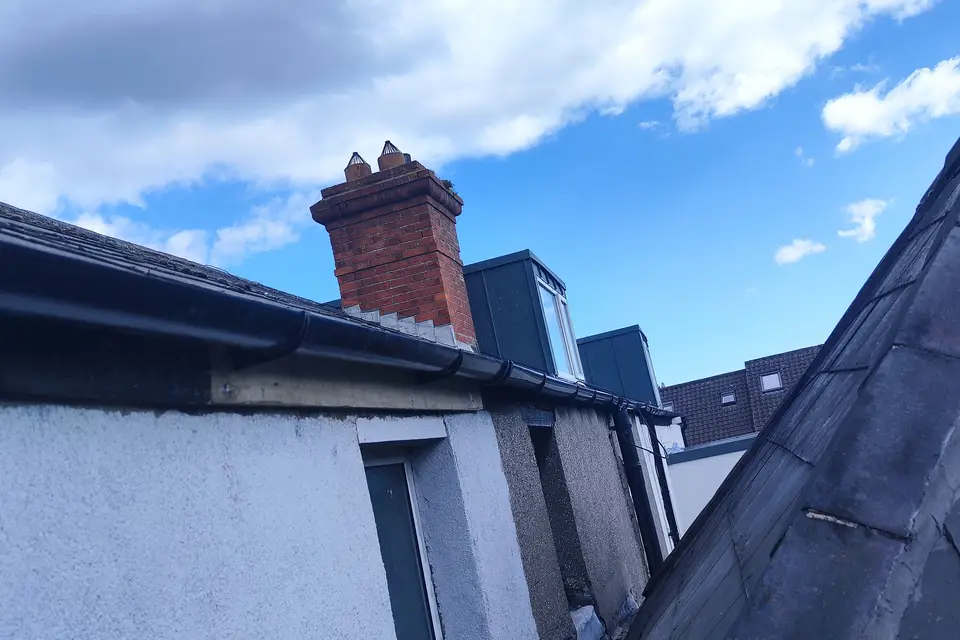
- Corner overflow
- Usually a valley sending a fast stream into one spot, or a corner that has dropped
- Middle of a run
- The gutter has lost its fall where a bracket has failed
- Clean but overflowing
- A blocked downpipe, lost fall or a gutter too small for the roof
- Overshooting
- A gutter set too low, or a perished drip at the eaves
Is it normal for gutters to overflow in heavy rain?
A gutter that spills for a minute or two during a cloudburst is not unusual, because domestic gutters are sized for heavy rain rather than the very worst downpour of the decade. A gutter that overflows every time it rains hard is a different matter, and on most Dublin houses it can be put right without replacing the whole system. Our gutter repairs page covers the work involved, and this guide explains how to read the problem from where the water comes over the edge.
The position of the overflow is the best clue to the cause. Spills at a corner, in the middle of a run, at the far end from the downpipe and over the front edge each point to something different, so it is worth watching the gutter from a window or the garden during a heavy shower before anyone climbs a ladder.
Overflowing at a corner
Corners take water from two directions, and on many houses one of those directions is a valley, the channel where two roof slopes meet. A valley collects rain from a large area of roof and delivers it in a fast stream to one point on the gutter. In a heavy shower that stream can shoot straight across the corner and over the front, even when the gutter is clean. The same thing happens where a short slope above a bay window or a porch drains into a corner.
The other common cause is the corner piece itself. Corner fittings on uPVC gutters hold their own seals and can drop slightly if a nearby bracket has failed, so water collects in the angle rather than running on, and leaves tend to gather there first. A drip from underneath the corner, rather than a spill over the front, is usually the seal, and our guide to a gutter leaking at the joint covers that repair.
Not sure what yours needs? WhatsApp us a photo and we will tell you what it looks like.
WhatsApp a photoOr get a free quoteOverflowing in the middle of a run
Water spilling from the middle of a straight length usually means the gutter has lost its fall. Gutters are set with a slight slope towards the outlet, and when a bracket breaks, works loose from soft fascia timber or is knocked by a ladder, the gutter sags between its neighbours. Water then pools in the dip, and in heavy rain it rises over the front edge at that point. You can often see the sag from the ground, or spot a line of moss and silt sitting in the same place after dry weather.
Resetting or adding brackets usually restores the fall. If the fascia behind is rotten, the brackets have nothing firm to hold, and the board needs attention before the gutter will stay put.
Gutters overflowing but not clogged
A clean gutter that still overflows has one of three problems. The first is a blockage further down, in the swan neck or the downpipe, which stops the outlet draining even though the gutter itself looks clear from a window. Our guide to a blocked downpipe explains how to tell from the ground. The second is lost fall, as described above. The third is capacity, where the gutter or the number of downpipes is too small for the area of roof feeding it.
Capacity problems are common on houses that have been extended, where a new roof slope now drains into an old gutter, and on long runs with a single downpipe at one end. Water spilling at the far end from the outlet in every heavy shower, while the gutter is clear and level, points that way. Adding a second outlet and downpipe, or fitting a deeper profile, is the usual answer.
Rain overshooting the gutter
On steep roofs, particularly slate roofs on older houses, rain can run off fast enough to jump clean over the gutter and land on the path. The gutter may be set too low or too far back under the eaves, or the eaves felt that should guide water into it may have perished or been cut short. In the second case water also falls between the gutter and the fascia, which rots the board from behind.
The fix depends on which it is. A gutter that sits too low can be reset higher on the fascia, while a missing or perished drip at the eaves can be extended so water lands in the gutter. Splash guards fitted at a valley corner can help where one strong stream overshoots, though they only treat that spot and need clearing like the rest of the gutter.
Splash guards at corners and valleys
Splash guards are small upstands fitted at a corner or under a valley to stop a fast stream of water shooting over the front of the gutter. They help at that one spot but do not cure lost fall or an undersized gutter. Leaf guards are a separate question, covered in our guide to blocked downpipes and whether gutter guards help.
Fixes, from a clean to a larger gutter
Most overflowing gutters need one of a short list of jobs, and the cheapest is often the right one.
- A clean of the gutters, outlets and downpipes, which is often all a gutter under trees needs. Our gutter cleaning service covers this, and our guide to gutter cleaning prices in Dublin gives rough figures.
- Brackets reset or added so the gutter falls to its outlet again.
- A new outlet and downpipe partway along a long run.
- A deeper uPVC profile where the existing gutter is too small for the roof.
- Fascia repairs where rotten timber is letting the brackets drop.
Replacement only makes sense when the gutters are brittle, leaking at several joints or too small throughout, and our guide to gutter replacement costs explains what drives the price. If your gutters spill every time it rains hard, a short video of the overflow sent on WhatsApp shows us where it is happening, and we give a free quote after looking at the whole run.
Frequently asked questions
Why does my gutter overflow at the corner?
Usually because a valley above it sends a fast stream of water into one spot, which can shoot across the corner in heavy rain. A corner that has dropped, or one packed with leaves, causes the same problem and is normally a quick repair.
How do I stop rain overshooting my gutter?
Water jumping over the gutter usually means it is set too low or too far back, or the felt at the eaves no longer reaches into it. Resetting the gutter or extending the drip at the eaves normally cures it, and a splash guard can help at a valley corner.
Will a bigger gutter stop my gutters overflowing?
Only if the existing gutter is too small for the roof. If it is blocked or has lost its fall, a bigger gutter will overflow in the same place, so the cause should be checked first.
What damage can an overflowing gutter do?
Water spilling down the wall soaks brickwork and render, rots the fascia and rafter ends behind the gutter, and can come through as damp on upstairs walls. Water pooling at the foot of the wall can also cause damp at ground floor level.
Why is water still sitting in my gutter after the rain stops?
A gutter should drain dry soon after the rain ends. Standing water means a dip where a bracket has dropped, or an outlet that is partly blocked, and both are worth fixing before the water spills over in the next downpour.