 SA Roofing
Flat roof repair vs replacement: how to decide
A leaking flat roof over an extension or garage can often be repaired, but sometimes a patch only delays a bigger bill. This guide explains how to tell which situation you are in.
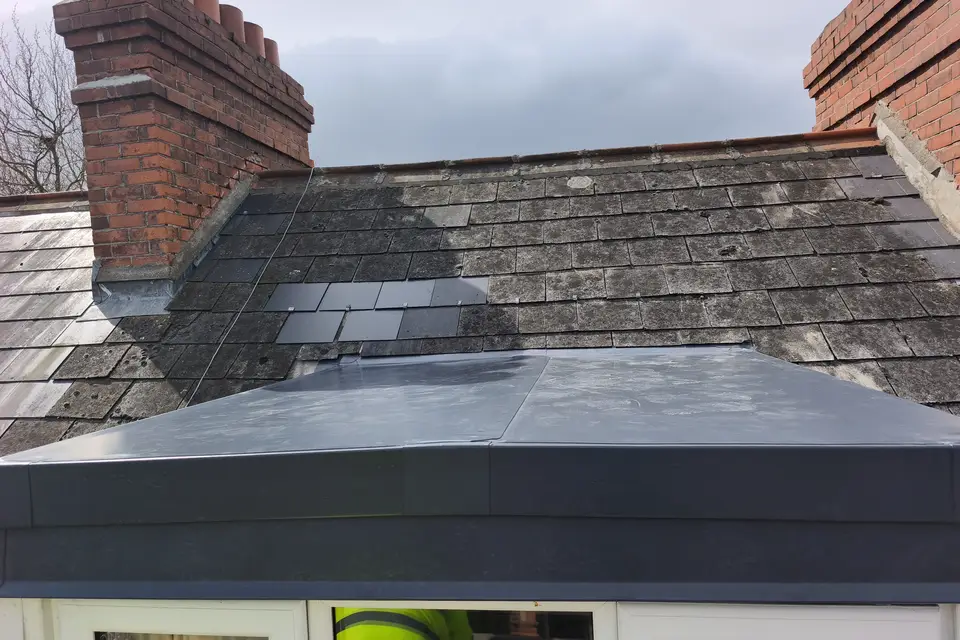
- Repair when
- The leak is in one spot and the deck around it is firm and dry
- Replace when
- Problems are spread across the roof: repeated patches, wide blistering, deep ponding, soft decking
- Deciding factor
- The condition of the deck under the felt
- Age
- Older built-up felt usually lasts around 10 to 20 years
Flat roofs on Irish homes
Flat roofs are everywhere in Dublin, on kitchen extensions, garages, dormers, porches and the back returns of older terraced houses. Most are covered in bitumen felt, either the older cold or hot applied built up felt, or modern torch-on systems where layers of reinforced membrane are heat bonded to the deck. Underneath the felt is a timber deck, usually plywood, OSB or older tongue and groove boards, sitting on joists.
A flat roof is never perfectly flat. It should have a slight fall so that rain runs to a gutter or outlet. When that fall is lost, or the covering breaks down, water starts to sit and find its way in. The question then is whether a repair will give the roof a few more good years, or whether it has reached the end of its life.
Common flat roof problems
Ponding water
Water that is still lying on the roof 48 hours after rain is called ponding. It puts constant pressure on joints and seams, speeds up the breakdown of the felt and, in winter, freezes and thaws in the same spot. Small, shallow puddles are common on older roofs. Large or deepening pools suggest the deck has sagged or the original falls were never adequate. Our guide to water pooling on a flat roof explains how the falls are corrected.
Blistering and bubbling
Blisters form when moisture or air trapped between the layers expands in the sun. A few small, intact blisters are not always urgent, but blisters that crack or split open let water straight in, and widespread blistering usually means moisture is already trapped in the build up.
Cracks, splits and failed seams
As felt ages it loses flexibility, and the movement of the deck in hot and cold weather opens up cracks, often along joints, at upstands against walls and around rooflights and outlets. These are frequent leak points on extension roofs.
Rotten or soft decking
If an area of the roof feels soft, spongy or bouncy when walked on carefully, the decking beneath has probably been wet for some time. Chipboard decks in particular lose strength quickly once wet. Rotten decking cannot be fixed from the top, and it is one of the clearest signs that a replacement, at least of that section, is needed.
Not sure what yours needs? WhatsApp us a photo and we will tell you what it looks like.
WhatsApp a photoOr get a free quoteWhen a repair makes sense
A repair is usually the right call when the problem is local and the rest of the roof is in decent condition. Typical examples are a single split from someone walking on the roof, a failed joint around a rooflight or soil pipe, a lifted edge at the drip detail, or a damaged upstand where the felt meets a wall. On a torch-on roof that is still relatively young, these can be cut out and patched with new membrane bonded to the existing surface.
A sensible roofer will check that the deck around the leak is dry and solid before patching. Putting new felt over wet or rotten boards traps the moisture and the problem returns, often worse than before.
- The leak comes from one identifiable spot
- The rest of the surface is flexible and free of widespread cracking
- The decking is firm and dry around the damaged area
- There is no significant ponding across the roof
- The roof is well within its expected lifespan
When replacement is the better option
Replacement starts to make more sense when problems are spread across the roof rather than in one place. Repeated patches that keep failing, blistering over large areas, deep ponding, soft decking in more than one spot, or a felt surface that is brittle and crazed all point the same way. Age matters too. Older built up felt roofs on extensions from the 1980s and 1990s are often well past the point where repairs give good value.
A full replacement typically involves stripping the old covering, replacing any rotten decking, correcting the falls where needed, and laying a new system such as a torch-on built up membrane with new edge trims, upstands and outlets. It is also a good opportunity to consider insulation, as many older extension roofs were built with little or none, although adding insulation needs to be designed properly to avoid condensation. Our guide to what flat roof repairs cost in Dublin gives rough ranges for both repair and replacement.
Age and expected lifespan
How long a flat roof lasts depends heavily on the material, the quality of installation and how well it drains. As a broad guide, older built-up or poorly installed felt roofs usually need attention after around 10 to 20 years, while a well installed multi layer torch-on system can last considerably longer. Our article on how long a roof lasts in Ireland covers expected lifespans for each material.
Questions to ask before deciding
- How old is the roof, and has it been patched before
- Is the leak in one place or several
- Does any part of the roof feel soft underfoot
- Does water sit on the surface for days after rain
- Is the gutter or outlet draining freely
- Would a replacement allow the falls or insulation to be improved
Getting the right advice
The difference between a good repair and a wasted one usually comes down to what is under the felt, so ask your roofer to explain what they found and, where possible, show you photos. A roofer who recommends replacement should be able to point to specific reasons, such as soft decking or widespread blistering, and one who recommends a repair should be confident the surrounding roof is sound.
SA Roofing installs, repairs and replaces felt and torch-on systems on extensions, garages and dormers. You can read more about our flat roof repairs and replacements, or see our roof repairs page for pitched roofs. If you cannot tell whether your flat roof needs a patch or a new covering, send us a few photos on WhatsApp and we will arrange a free inspection, then explain both options and what each would cost.
Frequently asked questions
Can a flat roof be repaired more than once?
Yes, a sound roof can take several local repairs over its life. When patches start to meet each other or new leaks appear every winter, the membrane is near the end of its life and replacement is usually better value.
How do I know if the decking is rotten?
Soft, spongy or sagging areas are the main sign, along with stains on the ceiling below that keep coming back after repairs. A roofer can confirm it by cutting a small inspection hole in the affected area.
Can a flat roof be repaired in wet weather?
Temporary emergency repairs can be made in poor weather to stop water getting in. Permanent torch-on repairs and replacements need dry conditions so that the membrane bonds properly, so they are scheduled for a suitable day.
What does a flat roof repair involve?
The damaged area is cut out back to sound membrane, the deck underneath is checked, and new torch-on felt is bonded over the repair and lapped onto the existing roof.