 SA Roofing
Extension roof leaking where it meets the house
The line where an extension roof meets the original wall is where most extension leaks start. This guide explains the four usual causes and how each one is put right.
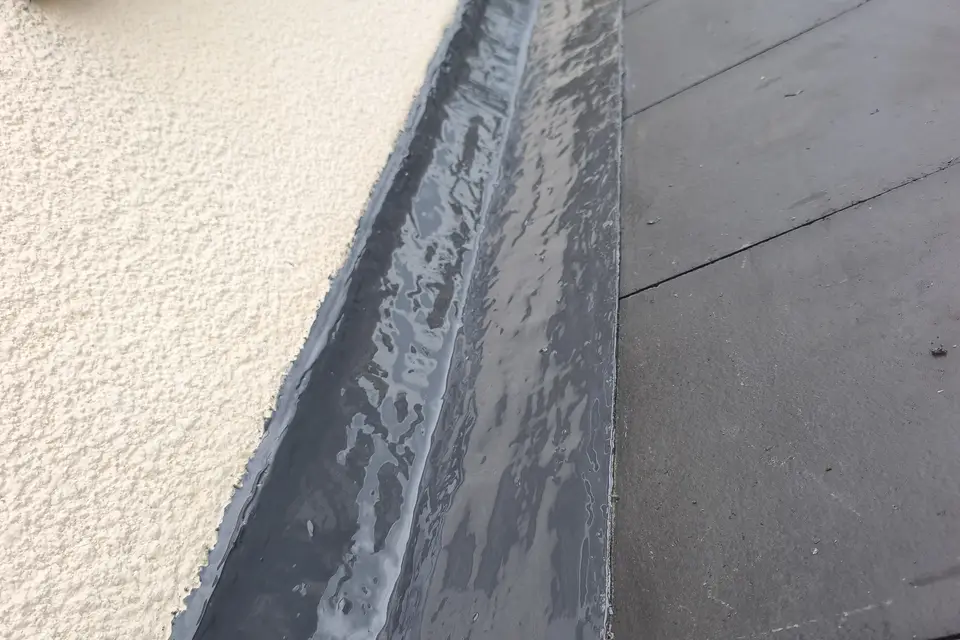
- Most common cause
- A cracked felt upstand or a loose flashing at the wall
- Upstand height
- At least 150 mm above the finished roof surface
- If the roof is sound
- Water may be running down inside the wall, which needs a cavity tray
- New extension
- Go back to the builder first
Why extensions leak where they meet the house
The joint between an extension roof and the original wall is the weakest point on most rear extensions in Dublin. Two structures meet there, built at different times, and they move slightly differently as the seasons change. The roof covering has to turn up the wall and be sealed so that rain running down the brickwork is carried out over the roof rather than behind it. When that detail fails, water appears on the ceiling just inside the extension, often in a line along the old wall. It is one of the most common reasons people need flat roof repairs, and it can usually be repaired without replacing the whole roof.
There are four usual causes: a failed upstand, a failed cover flashing, water coming down inside the wall above, and on some pitched extensions, tiles laid at too shallow a pitch. Each needs a different fix, so it pays to find out which one before any work is priced.
Upstands and flashings
On a felt or torch-on roof, the membrane is turned up the wall to form an upstand, which should rise at least 150 mm above the finished roof surface so that splashing rain and standing water cannot reach the top of it. A cover flashing, usually lead, is then tucked into a mortar joint in the brickwork above and dressed down over the upstand. The upstand keeps water out at roof level and the flashing stops it running in behind.
Both wear out. Felt upstands crack along the corner where they leave the roof, especially on older single-layer felt that has gone brittle in the sun, and they can peel away from a wall they were never properly bonded to. Flashings lift in the wind or come loose as the mortar holding them crumbles. Some extensions have no flashing at all, only a bead of mastic or a mortar fillet, which shrinks and cracks within a few years. Where the roof holds water near the wall the problem is worse, and our guide to water pooling on a flat roof explains why.
The repair is to cut out the failed section, bond in a new upstand to the right height and fit a proper cover flashing above it, chased into the brickwork.
Not sure what yours needs? WhatsApp us a photo and we will tell you what it looks like.
WhatsApp a photoOr get a free quoteWhen the water is coming from the wall above
Sometimes the roof is sound and the water is coming down inside the wall of the house. On cavity walls, rain that soaks through the outer leaf runs down the inside of the cavity. Where an extension roof meets that wall, a cavity tray should catch the water and turn it out over the roof. If there is no tray, or it was fitted badly, the water runs into the extension below, usually in wet, windy weather when the wall above is soaked.
A leak that carries on after the upstand and flashing have been renewed, or one that appears high up on the old wall inside the extension, points this way. Fitting or correcting a cavity tray is masonry work, because sections of the outer wall are taken out and rebuilt around it, and a builder normally carries it out. A roofer can confirm whether the roof detail is sound, which narrows things down.
Low-pitch tiled extension roofs
Some extensions have a lean-to roof covered in concrete tiles or slates rather than felt. Every tile has a minimum pitch set by its maker, below which wind-driven rain can be pushed up under the laps. Extensions are often built with a shallow slope to fit under a first-floor window, and where the pitch is lower than the tile allows, the roof can leak in strong wind even with every tile in place. The answer may be a membrane under the tiles, a covering suited to a low pitch, or rebuilding the slope.
New extension leaking: who is responsible
If the extension is only a few years old, contact the builder who put it up before paying anyone else to repair it. A leak at the junction of a new roof is usually a workmanship or design fault, and your contract with the builder sets out what happens next. Keep photos, dates and your correspondence in writing.
If the builder is no longer trading, or you want an independent view, a roofer can inspect the junction and tell you what has failed, and we are happy to do that and explain what we find.
Repair or re-cover the extension roof
A failed upstand on an otherwise sound roof is a repair. If the felt is brittle across the roof, the deck is soft underfoot, or water has been getting in long enough to rot the timber along the wall, re-covering the whole roof is usually better value, since a new upstand on old felt only moves the weak point. Our article on flat roof repair vs replacement covers that decision, and our guide to flat roof repair costs explains what drives the price. Dormers have a very similar junction where their flat roof meets the main roof, which our guide to a leaking dormer roof covers.
Getting it inspected
Note whether the leak appears in all rain or only in wind, and whether the stain is at ceiling level or higher up the wall. Photos of the junction from an upstairs window help as well. We check the upstand, the flashing and the felt around them, look at the ceiling and wall below, and give you a free quote for the work needed.
Frequently asked questions
How high should a flat roof upstand be?
The usual guidance is at least 150 mm above the finished roof surface, with a cover flashing chased into the wall and dressed down over the top. Lower upstands can be swamped by splashing rain or standing water.
Can mastic fix a leak where a flat roof meets a wall?
Only for a short while. Mastic shrinks and cracks as the roof and wall move, so the leak comes back. A proper upstand with a lead or similar cover flashing is the lasting fix.
What is a cavity tray?
It is a membrane built into a cavity wall above a lower roof, which catches water running down inside the cavity and turns it out over the roof. Without one, water can leak into an extension even when the roof itself is sound.
Does a leaking extension roof need to be replaced?
Usually not. If the leak is at the junction and the rest of the felt and deck are sound, renewing the upstand and flashing is enough. Replacement makes sense when the felt is brittle all over or the deck has gone soft.
Why does my kitchen extension only leak in windy weather?
Wind drives rain against the house wall and behind a loose flashing, or pushes it up under tiles on a low-pitched lean-to roof. If the roof detail is sound, water may be getting into the cavity of the wall above.