 SA Roofing
Roof only leaks in heavy rain? Causes and fixes
A roof that stays dry in a shower but drips in a downpour usually has one small fault. The pattern of the leak, when it starts and when it stops, is the quickest way to find it.
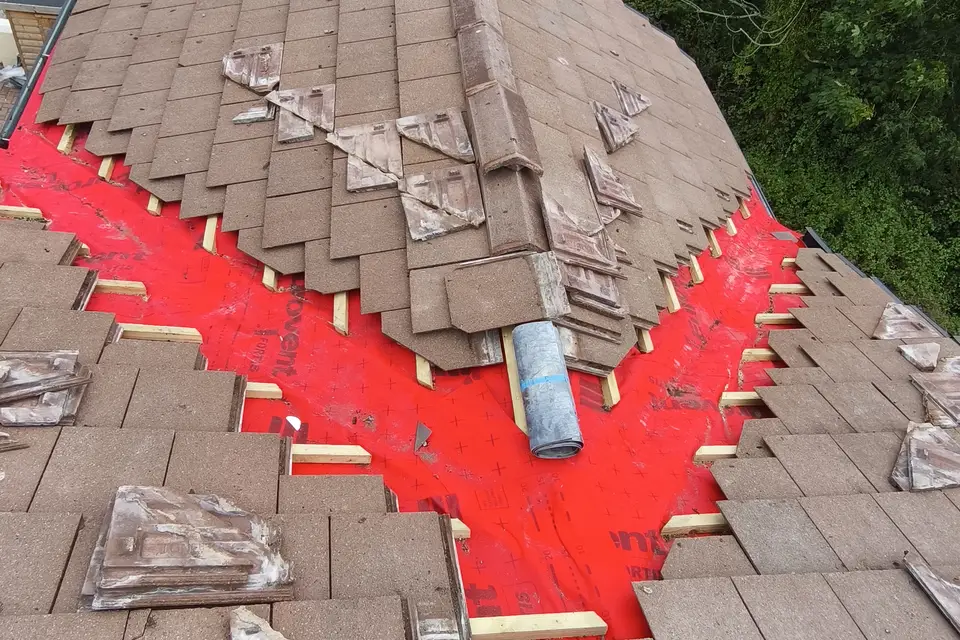
- Most likely cause
- A small defect that only heavy rain tests: a flashing, a slipped slate or tile, a valley
- Only in wind
- The side facing the wind, often a verge, a ridge or loose slates
- After rain stops
- Water tracking along felt and timber, then seeping out of insulation
- On cold, dry mornings
- Probably condensation rather than a leak
Why a roof can leak in heavy rain but not light rain
A roof that stays dry for months and then drips during a downpour is telling you something specific. Light rain runs down the slates or tiles and into the gutter without testing the weak points, while heavy rain puts far more water across the roof at once, raises the level in valleys and gutters and drives water into laps and joints that cope perfectly well the rest of the time. The fault is usually small, which is why roof repairs for this kind of leak are often modest jobs once the entry point is found.
The pattern of the leak is the most useful clue. Note when it starts, how heavy the rain was, which way the wind was blowing and how long the drip carries on afterwards. Those few details often narrow the search to one part of the roof before anyone goes up. Our broader guide to what causes roof leaks lists the usual suspects, and the sections below match them to the pattern.
Leaks that come with the wind
If the leak only appears when a strong wind blows from one direction, the weak point is usually on the side of the house facing that wind, which in Dublin is most often the south west. Driven rain is pushed sideways and even uphill, so it gets under slates whose fixings have loosened, through gaps in ridge and hip mortar, and behind flashings that have lifted at the edge.
Gable ends and verges are especially exposed. The mortar along the verge of many concrete tile roofs falls out over the years, and wind-driven rain then gets in under the end tiles. On older slate roofs, a slate that has slipped a little lets water reach the felt, or go straight into the attic where there is no felt at all. Our checklist of the signs your roof needs repair shows what loose verges and slipped slates look like from the ground.
Not sure what yours needs? WhatsApp us a photo and we will tell you what it looks like.
WhatsApp a photoOr get a free quoteWhy a roof keeps dripping after the rain stops
A drip that carries on for hours after the rain has finished does not mean the roof is still letting water in. Water that got past the covering during the downpour runs along the felt, the battens and the rafters until it finds a low point, and insulation soaks it up like a sponge and releases it slowly. The stain on the ceiling can keep growing well into the next day.
That delay makes the source harder to find, because the drip is often some distance from the entry point and the timing no longer lines up with the weather. Looking in the attic with a torch soon after heavy rain usually shows a trail of damp timber leading back up the slope.
Leaks below valleys, flashings and gutters
Some leaks appear in the same spot after every heavy shower, whatever the wind. These are usually under a part of the roof that collects water. A valley carries the run-off from two slopes and can overflow its lining in a downpour if it is partly blocked with moss or the lining has split. Lead flashings at a wall or a rear return can let water behind them when the rain is heavy enough to back up against the joint.
Gutters can cause the same symptom. When a gutter overflows at the back, water runs behind the fascia and into the top of the wall, and from inside it looks very like a roof leak. Our guide to gutters overflowing in heavy rain explains how to check for that from the ground. A chimney can also leak only in heavy rain, through cracked flaunching or porous brickwork, and a damp patch on the chimney breast is the usual sign.
Is it condensation instead?
Damp that appears on cold, still mornings, often in dry weather, is more likely to be condensation than a leak, especially after an attic has been insulated and the vents at the eaves covered. Our guide to condensation in the attic shows how to tell the two apart.
What it costs to fix
The cost depends on what is letting the water in, not on how often it leaks. Refixing a few slates, renewing a short length of flashing or clearing and repairing a valley are among the smaller roof repairs, while a valley that needs relining or a verge that needs rebedding along its whole length takes longer. Access matters too, since a leak above a three-storey front needs more equipment than one over a single-storey return. Our guide to roof repair costs in Dublin gives rough ranges for common jobs.
Getting it traced
Write down when the leak appears and which way the wind was blowing, take dated photos of the stain and, if you can get into the attic safely, look for wet timber above it. Please stay off the roof itself, particularly in wet weather. With that information we can usually go straight to the likely area, check the roof inside and out, and give you a free quote for the repair. If water is pouring in now, our emergency roof repairs line runs 24/7.
Frequently asked questions
Is it normal for a roof to leak in heavy rain?
No. A sound roof should stay dry in the heaviest Irish downpour, so a leak that only appears in heavy rain usually points to a defect such as a cracked flashing, a slipped slate, a blocked valley or a gutter overflowing back under the eaves. These tend to get worse with each storm.
What makes a roof leak in a downpour but not in a shower?
Heavy rain puts much more water on the roof at once, fills valleys and gutters and pushes water into laps and joints that cope with light rain. A slightly lifted flashing, a slipped slate or a partly blocked valley is usually enough.
Can a blocked valley cause a leak only in heavy rain?
Yes. Moss and leaves in a valley slow the water down, and in a downpour it rises over the edge of the lining and runs in under the slates or tiles. The stain usually shows on an upstairs ceiling near a corner.
When should I worry about a roof leak?
Straight away if water is coming in steadily, a ceiling is bulging or anything on the roof is loose. A small leak that only appears in downpours is less urgent but still worth booking in before the winter, because each storm soaks the timber a little more.
Can I find the source of a heavy-rain leak myself?
You can narrow it down safely by noting the wind direction and timing, and by checking the attic with a torch for wet timber above the stain. Leave the roof itself to a roofer, because wet slates and moss are treacherous.
Should I wait for the next downpour before calling a roofer?
There is no need. Tell the roofer when the leak appeared, what the weather was doing and where the stain is, and send photos. That is usually enough to know where to look, and the roof can be inspected in dry weather.