 SA Roofing
Slipped slates: why they happen and how they are fixed
A slate sitting lower than its neighbours is one of the most common sights on older Dublin roofs. This guide explains why slates slip, how urgent it is, and when a few repairs turn into a re-slate.
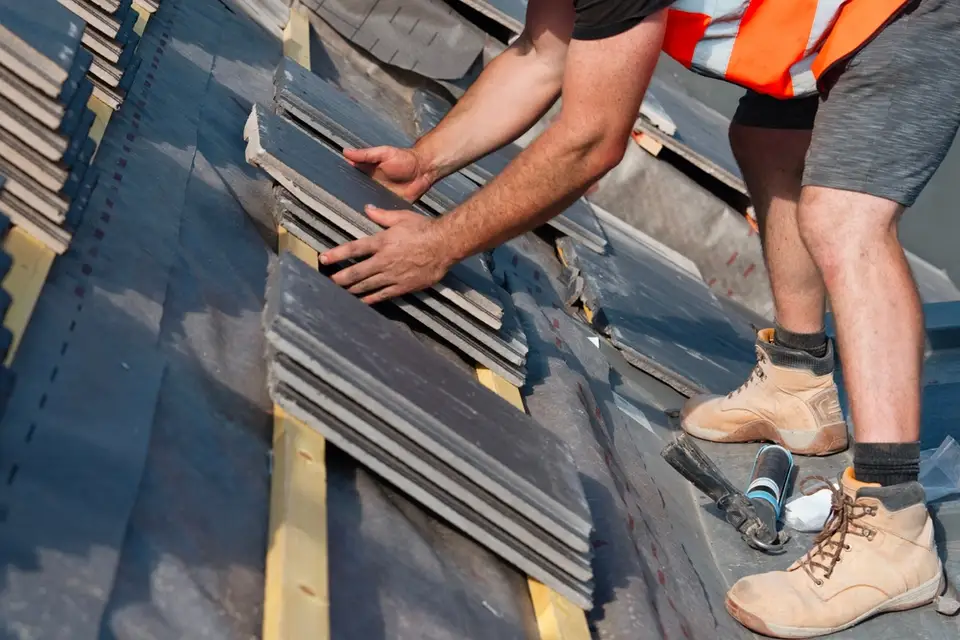
- Main cause
- Nail sickness, where the original iron nails rust through
- Is it urgent
- Not usually for one slate, unless it hangs over a path or water is coming in
- The fix
- Refixed with a tingle or a clip, because it cannot simply be nailed back
- Re-slate when
- Slates slip all over the roof every winter
Why slates slip
A natural slate roof is held together by nails, two to each slate, driven through holes near the head or the middle of the slate into the timber battens below. On a Victorian or Edwardian house those nails are usually the original iron ones, and after a century or more of damp Irish weather they rust through. The slate is then held only by friction and the slates around it, and sooner or later it slides down the roof. Slipped slates are one of the commonest problems on older Dublin houses, and refixing them is a routine part of our slate and tile repairs.
Roofers call this nail sickness or nail fatigue. Other causes include frost, which can split a slate that has absorbed water, high winds that lift slates on exposed roofs and near the coast, where salt air speeds up corrosion, and people walking on the roof to fix aerials or satellite dishes.
Battens can also be the problem. Where the timber has rotted, the nails have nothing to grip, and slates come loose even when the nails themselves are sound.
What is nail sickness?
Nail sickness is when the nails holding the slates on a roof rust through, usually after many decades on older Irish slate roofs. Slates then slide out one at a time. Because every nail on the roof is the same age, it rarely affects just one slate, and widespread slipping often means the slope needs re-slating.
Not sure what yours needs? WhatsApp us a photo and we will tell you what it looks like.
WhatsApp a photoOr get a free quoteIs a slipped slate an emergency?
A single slipped slate is not usually an emergency, but it should be refixed before the next spell of bad weather. It becomes urgent when a slate has fallen or is hanging over a path, when water is coming in, or when several slates have moved after a storm. In those cases, keep people clear and call an emergency roofer.
The slate above overlaps the gap, so a small slip may not let in much water at first. Once the slate has slid a few centimetres, rain reaches the felt and battens directly, and on older roofs with no felt it goes straight into the attic.
A falling slate can cause serious injury, so if one is hanging loose, keep people away from that side of the house and ring our 24/7 emergency line. Our guide on what to do in a roofing emergency covers the steps to take while you wait.
How a slipped slate is refixed
Because each slate is nailed under the course above it, a slipped slate cannot simply be nailed back in place without lifting the slates around it. Roofers use one of a few standard methods instead.
Tingles
A tingle is a narrow strip of lead or copper fixed to the batten through the gap between the two slates below, then folded up to hold the bottom edge of the refitted slate. It is the traditional fix and works well for an occasional slate, although the strips can be seen from close up.
Slate hooks and clips
Stainless steel or copper hooks and clips do the same job more neatly. The clip is fixed to the batten, the slate is slid back into place, and the clip holds its tail. On a roof with several slipped slates, clips are the usual choice.
Replacing broken slates
Where a slate has cracked or broken on its way down, a matching replacement goes in, held by a tingle or a clip. While the gap is open, the felt and batten underneath are checked as well.
Natural slate, fibre cement and matching
Matching the replacement matters for looks and for keeping the roof watertight. Many older Dublin roofs have Welsh or Irish natural slate, and close matches can usually be found. Natural slate varies in colour, thickness and size, so a roofer will choose the nearest match rather than any slate that fits.
Houses built from the 1970s onwards often have fibre cement slates instead. These are uniform when new but fade over time, and some older ones contain asbestos, so a broken fibre cement slate should be assessed by a professional before anyone drills, cuts or removes it. Mixing natural and fibre cement slates on one slope looks wrong and can cause problems at the laps, so like for like is the rule. If your roof is concrete or clay tile rather than slate, our guide to a missing or slipped roof tile covers the causes and fixes for tiles.
When it is time to re-slate
A few slipped slates are a repair. Slates slipping all over the roof every winter, or a roof covered in tingles from years of patching, are signs that the fixings have failed across the whole slope. At that point each repair buys less time than the last, and stripping and re-slating starts to make more sense.
Re-slating does not always mean new slates. Good natural slate often outlasts its nails by decades, and on a careful re-slate the sound slates are taken off, stored and refixed with new nails onto new battens and a breathable membrane, with matching slate making up any shortfall. Our article on how long a roof lasts in Ireland covers the lifespan of slate and other coverings.
What affects the cost of slipped slate repairs
There is no fixed price for refixing slates, because the slate itself is the cheap part. Access is usually the biggest factor. A slipped slate on a single-storey return can be reached from a roof ladder, while the same slate on the front of a three-storey house may need a tower or scaffolding. The number of slates involved, whether replacements have to be sourced to match, and what is found underneath once the gap is open all affect the price too.
Our guide to roof repair costs in Dublin gives rough ranges for common repairs. If you can see a slate sitting low from the footpath, a photo on WhatsApp is usually enough for us to tell you how soon it needs refixing, and we confirm the price after a free inspection.
Frequently asked questions
How much does it cost to refix a slipped slate?
The slate is the cheap part, and access decides most of the price, since a slate on a single-storey return can be reached from a roof ladder while one on a three-storey front may need a tower. Our guide to roof repair costs in Dublin gives rough ranges.
Can a slipped slate be refixed without replacing it?
Yes, if the slate is not cracked. It is slid back into position and held with a lead or copper tingle, or a stainless steel or copper clip, fixed to the batten below.
Does nail sickness mean the whole roof needs re-slating?
It often does in the end, because every nail on the roof is the same age, but a few slipped slates can be refixed with clips or tingles for some time first. When slates slip all over the roof every winter, re-slating with the sound slates reused is usually better value than more repairs.
Can I put a slipped slate back myself?
We would advise against it. Wet slate and moss are very slippery, old slates crack underfoot, and a fall from even a single-storey roof can be serious. A roofer can usually refix a slate quickly from a roof ladder.
Can natural slate be repaired?
A cracked slate cannot be glued or patched, but individual slates can be replaced or refixed, and good slates can often be reused when a roof is re-slated.